Milton Centennial Pool
We are considering not opening the Milton Centennial Pool for the 2026/27 season, for a few key reasons. Read more about this and let us know what you think.

Council is proposing to change the funding model for the Clutha District’s Rural Water Schemes, to ensure that our schemes remain financially sustainable, meet capacity, and fairly distribute costs while accounting for certain risks, such as potential withdrawals from the schemes.
Rural water schemes contribute substantially to the economy of the wider Clutha District. Currently, Rural Water Schemes are funded from a 100% targeted rate per unit of water supplied, with the cost varying between each scheme.
Council is proposing to change the funding model to introduce availability charging and assistance capping. There is more information about both of these topics below, as well as information about the changes we would need to make to Council's Revenue and Financing Policy.
Council is proposing to introduce an availability charge of 50% to each rural water scheme in our district.
This would mean that 50% of the unit price is applied to property owners that have reduced the number of units they are receiving since 1 July 2023, where those units have not been transferred to another customer.
Availability charges will not apply if the units have been transferred to another property on the same scheme.
As rural water schemes have been designed for specific levels of supply, and water schemes are paying for multi-generational decisions, availability charging ensures that costs are shared fairly when units are reduced. Availability charging is currently applied in urban water rating areas.
| Partial Unit Reduction | Full Disconnection | |
| RWS Unit Price | $500 | $500 |
| RWS units on 1 July 2023 | 10 | 10 |
| Units reduced since 1 July 2023 (not transferred to another customer on same RWS) | 2 | 10 |
| 50% Availability Charge ($250 per unit) applies to | 2 units | 10 units |
| Remaining RWS units for Customer | 8 | 0 |
| Total cost for customer without Availability Charge | $4,000 | $0 |
| Total Cost for Customer with Availability Charge | $4,500 | $2,500 |
Partial Unit Reduction: Customer has reduced two units since 1 July 2023, and retained the remaining 8 units.
Full Disconnection: Customer has eliminated all of their 10 units since 1 July 2023, and has no units remaining.
Council is also proposing to introduce an assistance cap that limits the per-unit water rates for all of our rural water schemes.
This means that the rate per unit would be limited to no more than 20% above the weighted average of all unit prices in the Clutha District. Council also welcomes feedback on this level of capping.
Assistance capping would benefit schemes that are currently paying well above the average unit rate, as they would be supported by the rates collected from other schemes. This seeks to address financial sustainability issues with individual rural water schemes. Rural water schemes contribute substantially to the economy of the wider Clutha District.
From 1 July 2027, rural water schemes will be managed by the Southern Waters CCO. Should the CCO continue with this model, it is estimated that assistance capping will benefit more schemes, and the overall support from other schemes will diminish. However, it will be the CCO’s responsibility to determine the most suitable funding model.
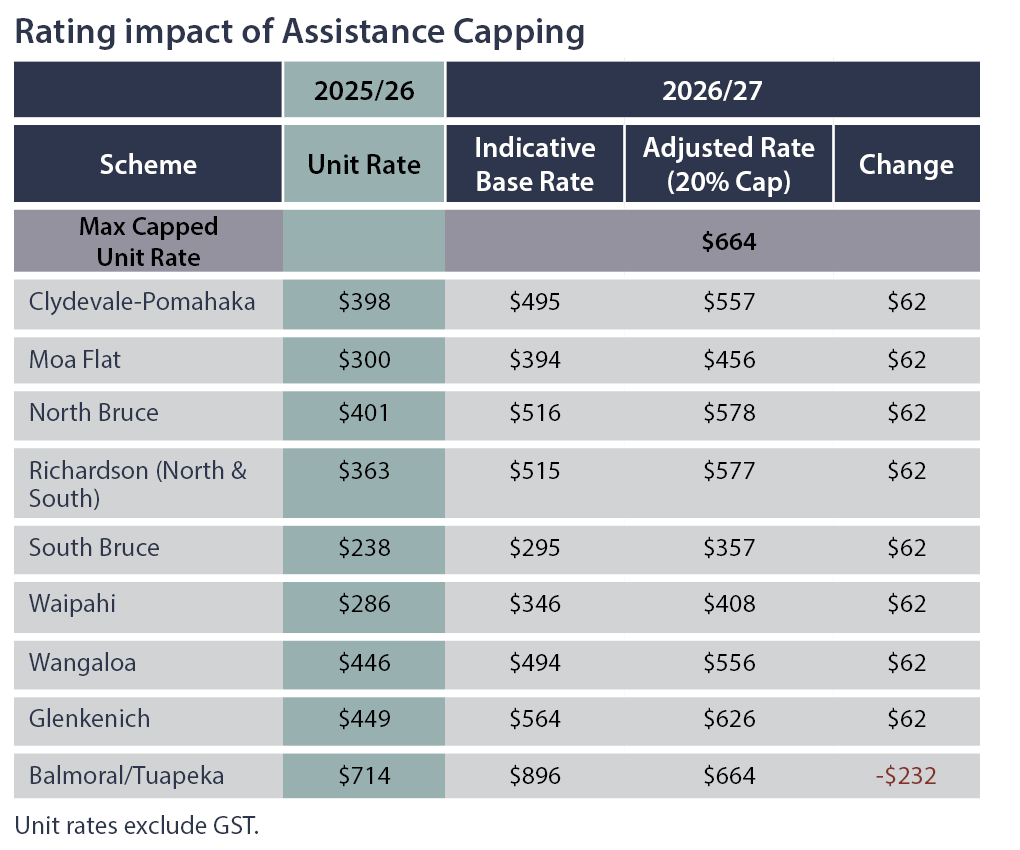
The proposed introduction of availability charging and assistance capping will mean that we need to make some changes to the Rural Water section of Council’s Revenue and Financing Policy.
The policy is subject to final legal review once Council makes its decisions on funding models for our rural water schemes. Tell us what you think about these changes when you give us your feedback.
Click here to view the proposed changes to the Revenue and Financing Policy.
We are considering not opening the Milton Centennial Pool for the 2026/27 season, for a few key reasons. Read more about this and let us know what you think.
Due to their close working relationship, the proximity of the two facilities, and their shared need for renewal work, it is feasible to incorporate the Tapanui Community Library into the West Otago Community Centre to create an integrated community hub.
You can read more about this, view the plans, and let us know what you think about potentially funding the integration of these two facilities.
The Voluntary Targeted Rating (VTR) scheme allows Clutha District ratepayers to fund additional services that benefit them directly. Voluntary targeted rates are self-funding, meaning rates funding is not required.
Council is considering recommencing the VTR scheme from 2026/27 for a few specific activities, and we want to know what you think.
Urban water rating maps have been reviewed, and some minor changes have been made to ensure they reflect existing urban and some transition areas of the District Plan. The changes made also reflect urban growth.
Within the urban water areas, a serviceability charge applies where water supply is available. This charge generally does not apply when a rating unit is being supplied by the network and a water rate is being charged.
Property owners can review the maps and give us their feedback.
Have questions or want to learn more about a project, contact us below:
| Phone | 0800 801 350 |
|---|---|
| Website | www.cluthadc.govt.nz/ |
| In writing | PO BOX 25, BALCLUTHA 9240, NEW ZEALAND (Physical address: 1 Rosebank Terrace, Balclutha) |